
Hampi is one of those places where the obvious photograph is always waiting for you.
The Stone Chariot. The great gopuras. The pillared halls. The Elephant Stables. The vast boulder-strewn landscape.
They are magnificent, and naturally the camera is drawn towards them. But over repeated visits to Hampi, I have realised that photographing this place is not really about recording monuments. It is about deciding how you want to look at them.
Sometimes I stand far away and allow architecture to become part of the landscape. Sometimes I go almost to ground level and let a small flower dominate an empire. At other times, I hide the sun behind a tree, use a broken sculpture as my foreground, look into a puddle rather than directly at a wall, or allow a lone human figure to become almost insignificant against the vastness of Hampi.
Photography, after all, is an act of selection.
Move a few feet, lower the camera, change the lens, wait for the light, and the same monument begins to tell a completely different story.
This collection is therefore not intended as a catalogue of Hampi’s monuments. It is a collection of perspectives: different ways in which I encountered the surviving world of Vijayanagara.
Where the Light Remains
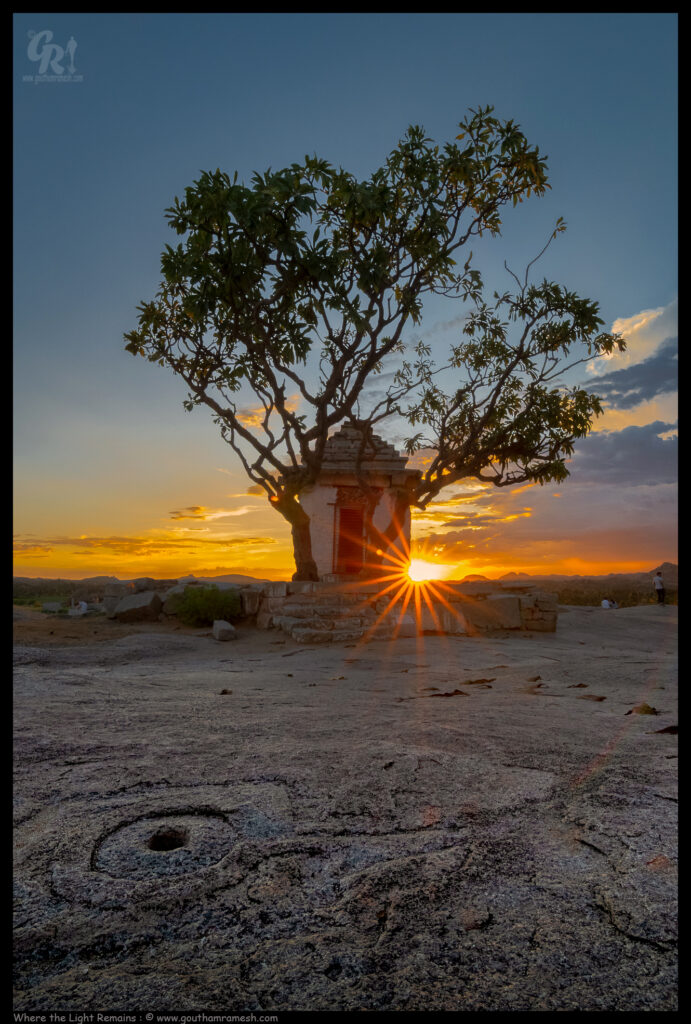
There is something magical about placing the sun exactly at the edge of an object.
For this photograph on Hemakuta Hill, I positioned myself low and kept moving until the setting sun appeared from beside the little shrine, producing the starburst. The tree was equally important to the composition. Its branches spread across the sky almost like a natural canopy, while the small shrine sits beneath it, caught between stone, tree and fading light.
The linga carved into the rock in the foreground might easily have been ignored. Instead, I allowed it to occupy a considerable portion of the frame. It creates a visual path from the ancient markings beneath my feet, through the shrine, and finally towards the sun.
That is the perspective I wanted here. Not simply a photograph of a temple at sunset, but a photograph about layers of time.
“Stone beneath us. A shrine built upon it. A tree that arrived later. And sunlight that has crossed this landscape every evening for centuries”
The monument survives, but perhaps what really remains is the light.
Devotion Beyond the Temple
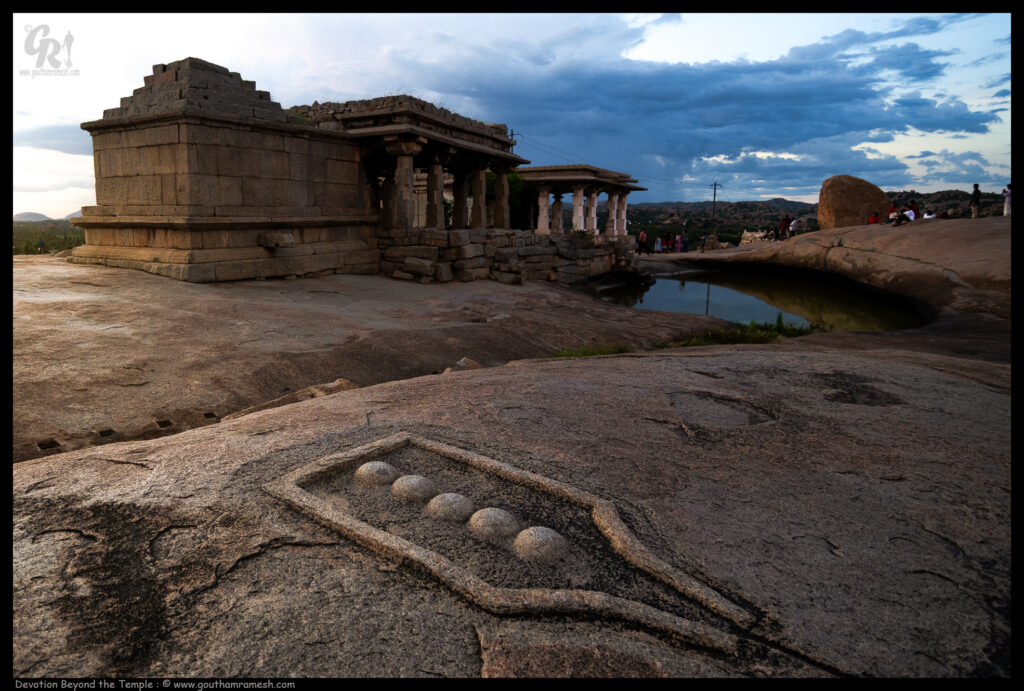
One of the fascinating things about Hampi is how ritual seems to extend beyond architectural boundaries.
Here, instead of beginning with the temple, my attention went immediately to the small row of small lingas carved directly into the rock. They occupy only a tiny physical space, yet by bringing the camera close to the ground they become the dominant foreground.
Behind them stands the temple structure, while the naturally formed water tank occupies the right side of the frame.
This low viewpoint changes the hierarchy of the photograph.
Had I photographed standing upright, the temple would naturally have dominated. By lowering the camera, the small devotional detail becomes our entrance into the image. The eye moves from the carved stone forms to the temple and then towards the pool and landscape beyond.
Hampi often rewards this kind of photography.
The grand architecture tells us about kings and empires. The small marks in the stone tell us something equally important: how people interacted with this sacred landscape.
Sometimes history survives not in monuments, but in gestures.
Fragrance Among the Stones
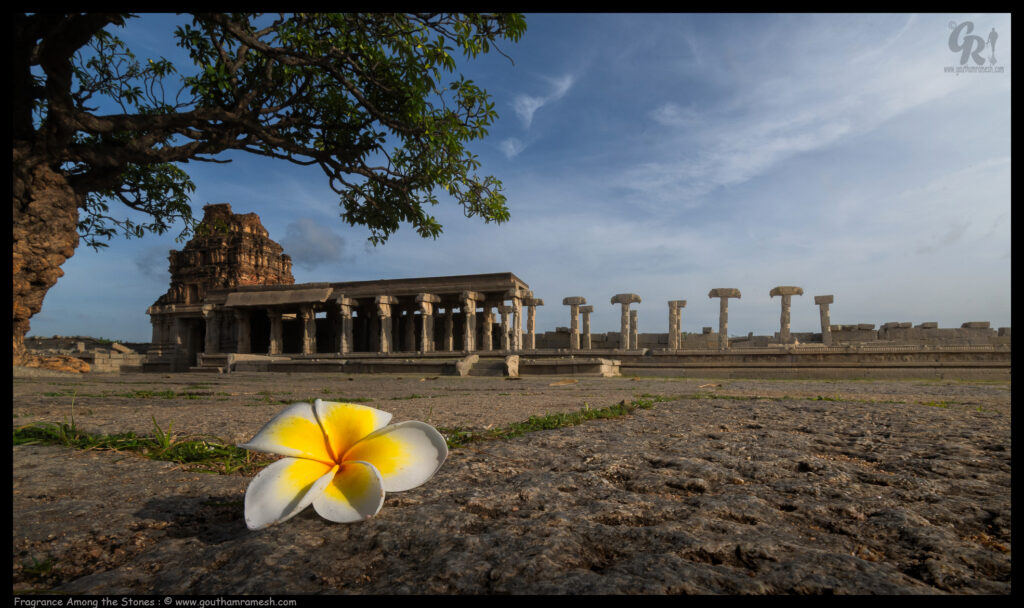
A fallen frangipani flower lay quietly on the ground at the Vijaya Vittala complex.
Behind it stood centuries of architecture. That contrast immediately interested me.
I placed the camera almost at ground level and went extremely close to the flower, allowing it to become enormous relative to the temple behind it. The architecture is still clearly recognisable, but it is no longer automatically the protagonist.
For once, the smallest and most temporary object in the scene takes centre stage.
There is an interesting contradiction here. Stone survives for centuries, while the flower may survive only a day. Yet in this photograph it is the flower that seems alive, luminous and immediate, while the magnificent architecture behind it becomes memory.
Perspective can completely change our understanding of scale. The flower is tiny and the temple enormous, yet photography allows me to reverse that relationship.
Perhaps that is why I enjoy working with foregrounds so much. They do more than create depth. They allow us to create relationships between objects that otherwise have almost nothing in common.
A flower and an empire. One will disappear tomorrow, the other has already outlived generations and for one brief photograph, they exist together.
Grace at Dusk, Malyavantha
Hampi is not only about architecture. It is also about space.
From Malyavantha Hill, the landscape seems to open endlessly towards the horizon. Rocks, fields, vegetation and distant hills merge into a vast panorama.
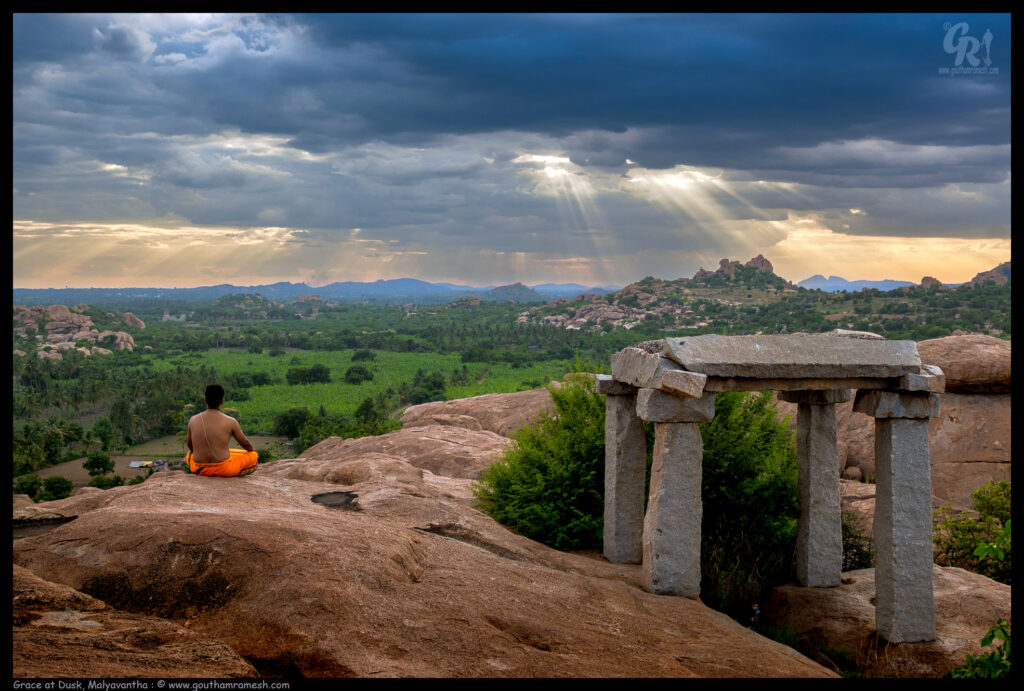
Then I noticed the lone person seated on the rock. The figure is deliberately small in the frame. I did not want this to become a portrait. The person is instead a measure of scale, almost a punctuation mark against the immensity of the landscape.
To the right stands a fragment of stone architecture. Above, shafts of sunlight descend through openings in the clouds.
The composition therefore became a conversation between three elements: the human figure, the remains of architecture and nature.
All three occupy very different scales.The person is temporary, the architecture has endured for centuries, and the landscape is older than both. And yet the human figure gives the photograph its emotional centre.
Sometimes photographing Hampi requires looking beyond the ruins themselves. The ruins become most meaningful when we understand how small they are within the larger landscape, and how small we are within both.
Path of Devotion at Hemakuta
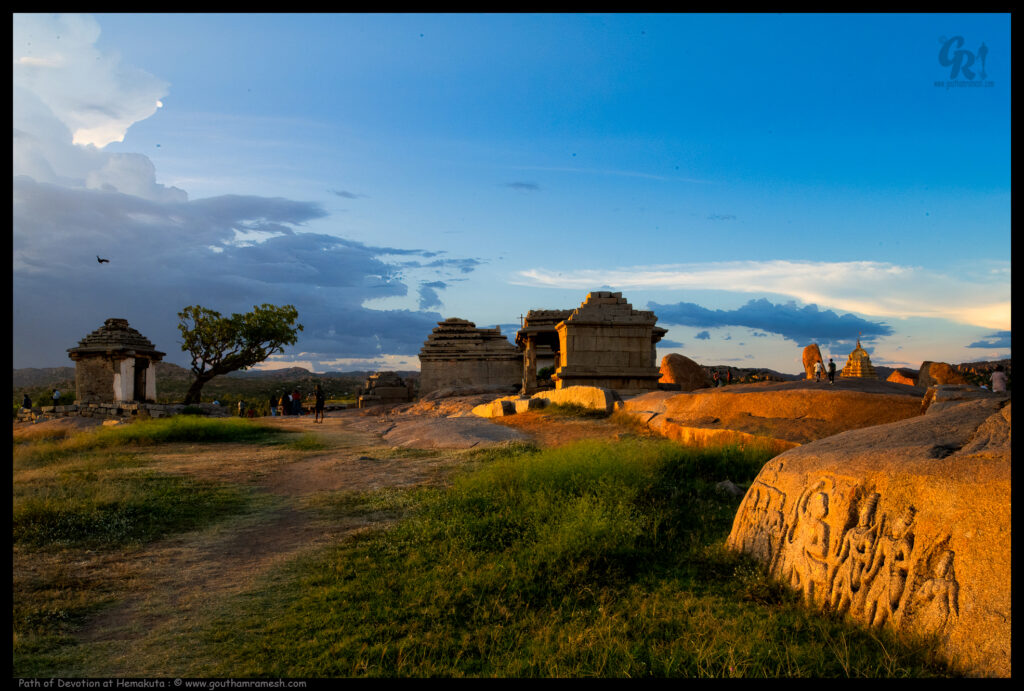
Late evening light can transform Hemakuta Hill.
The granite begins to glow, small shrines catch the last warm light, and the entire hill changes character.
In this photograph I intentionally avoided isolating a single temple. Instead, I wanted the image to feel like a journey through the hill.
The path enters from the lower left and naturally leads the eye towards the structures. The warm granite on the right becomes another visual guide, carrying us deeper into the scene. The carved rock in the foreground creates a first point of interest before the eye travels further.
What interests me about Hemakuta is precisely this relationship between individual shrines and the landscape.
Unlike photographing a single monument symmetrically, this wider perspective communicates something about how the place feels when you walk through it.
Temple after temple appears among boulders and open ground, Architecture here does not dominate nature, it seems to grow out of it.
That relationship between rock and shrine is, for me, one of the defining visual signatures of Hampi.
Whispers of the Last Light at Hanuman Temple
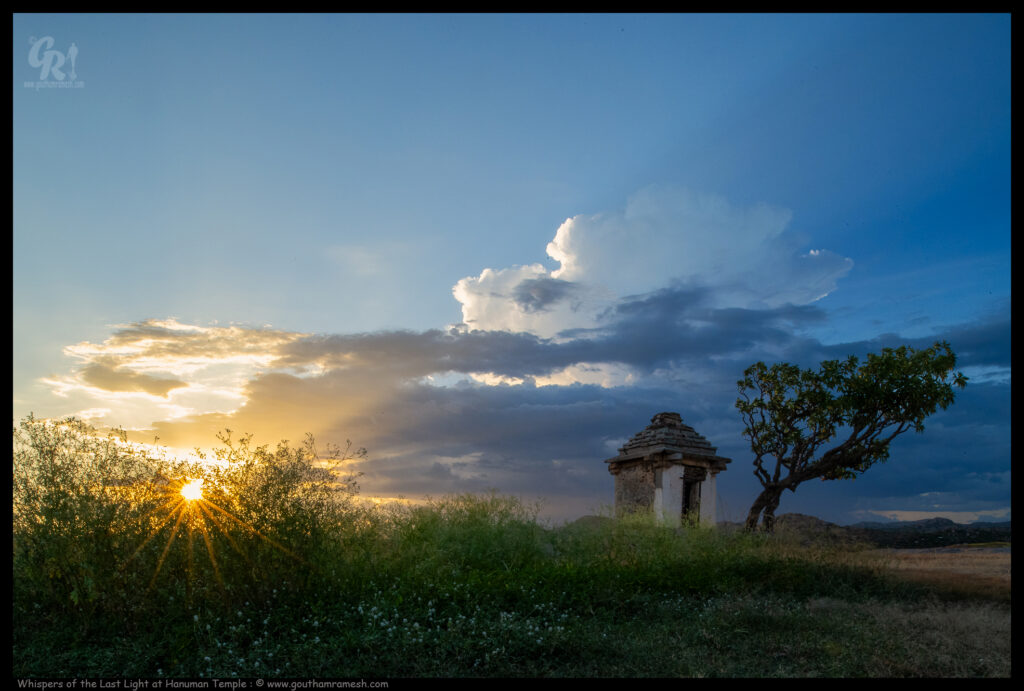
Sometimes the most important decision in landscape photography is knowing what not to include.
Here I resisted the temptation to move closer to the little temple.
Instead, I stepped back.
The temple and tree became relatively small elements on the right while the evening sky was allowed to dominate the photograph. On the left, the sun appears through the vegetation as a small starburst.
The enormous amount of sky is intentiona it gives the image breathing room and turns the temple into something almost fragile beneath the approaching evening. There is also a wonderful transition occurring across the frame. Warm golden light enters from the left, while cooler blue tones settle over the right. Day and evening seem to occupy the photograph simultaneously. This is why I enjoy photographing during transitional light.
Sunrise and sunset are beautiful, certainly. But the moments surrounding them are often more interesting photographically. Light changes quickly. Colours separate. Shadows lengthen. Familiar structures become unfamiliar.
For a few minutes, Hampi stops being archaeology and becomes atmosphere.
Horsemen of a Trading Empire
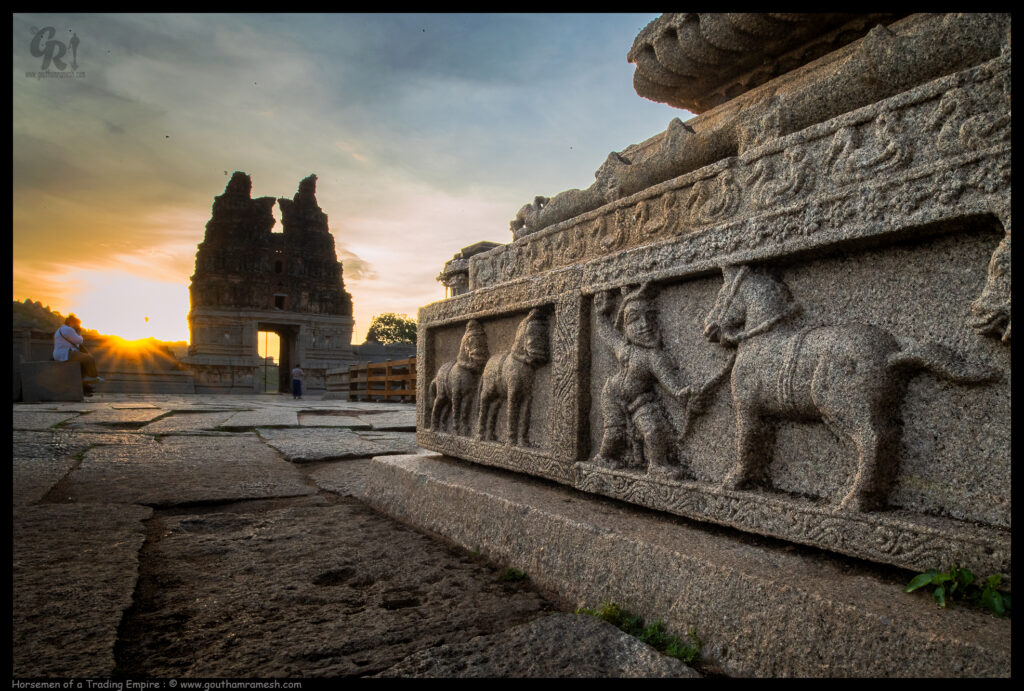
The great monuments of Vijayanagara tell us about political power, but sometimes the smaller carvings tell us more about the world that existed around them.
At the Vijaya Vittala complex, these horsemen immediately caught my attention.
Instead of photographing the sculptural panel straight on, I moved very close to it and allowed it to dominate the right side of the frame. The gopura then becomes part of the background, with the setting sun entering from the opposite side.
The exaggerated near–far relationship was intentional. The horsemen become visually dominant, while the gateway, although physically much larger, recedes into the background and appears comparatively small. It is another example of how perspective can alter the visual hierarchy within a photograph.
These carved horses and riders are especially evocative because Vijayanagara was deeply connected to trade networks extending beyond South India, including the import of horses from western Asia. I therefore wanted the carving to be more than a decorative element in the frame. It becomes the subject, while the monument behind it provides the context. A small stone relief thus becomes a window into movement, trade and the wider world with which Vijayanagara was connected.
Sometimes history is hiding in the margins of architecture.
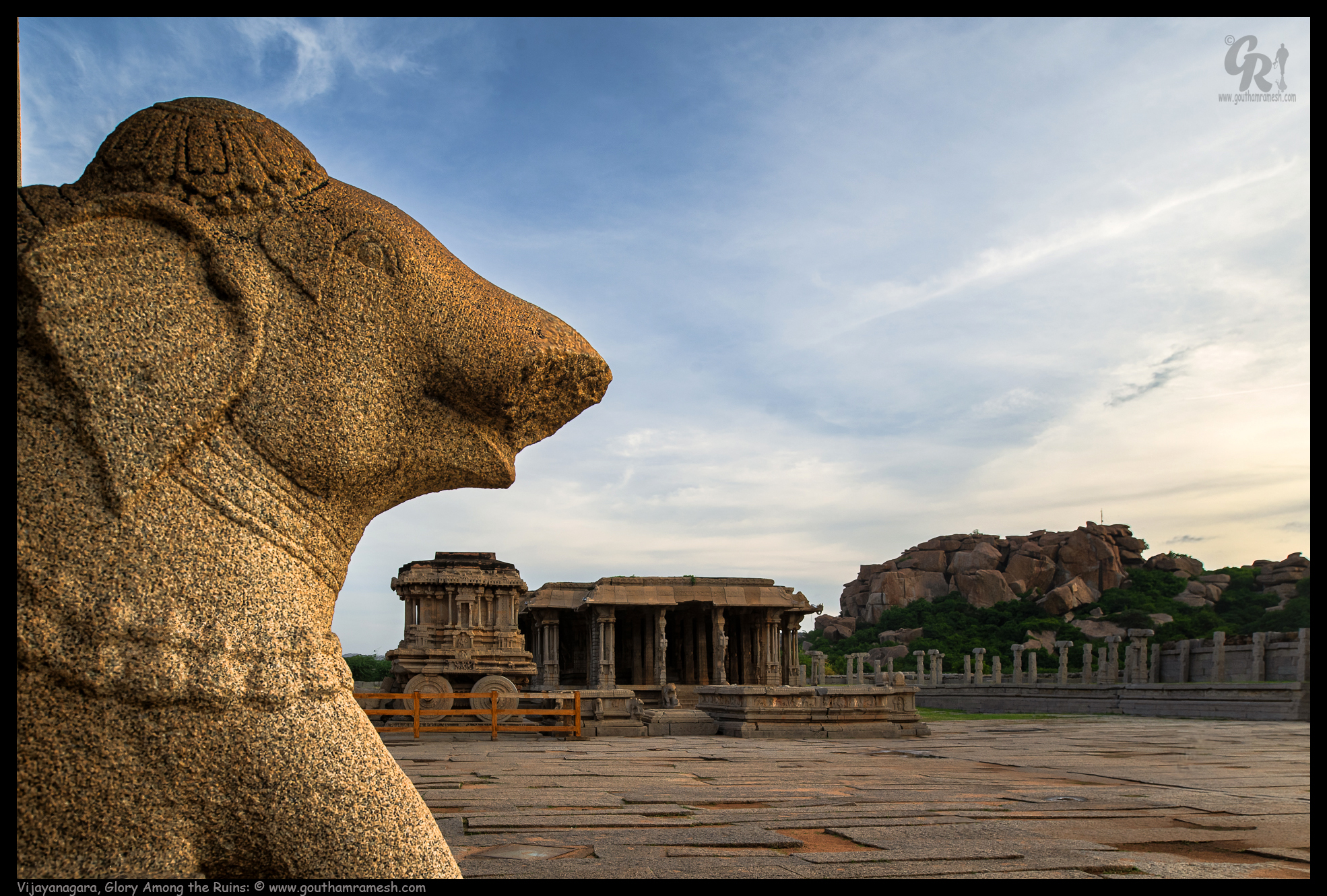
Vijayanagara, Glory Among the Ruins
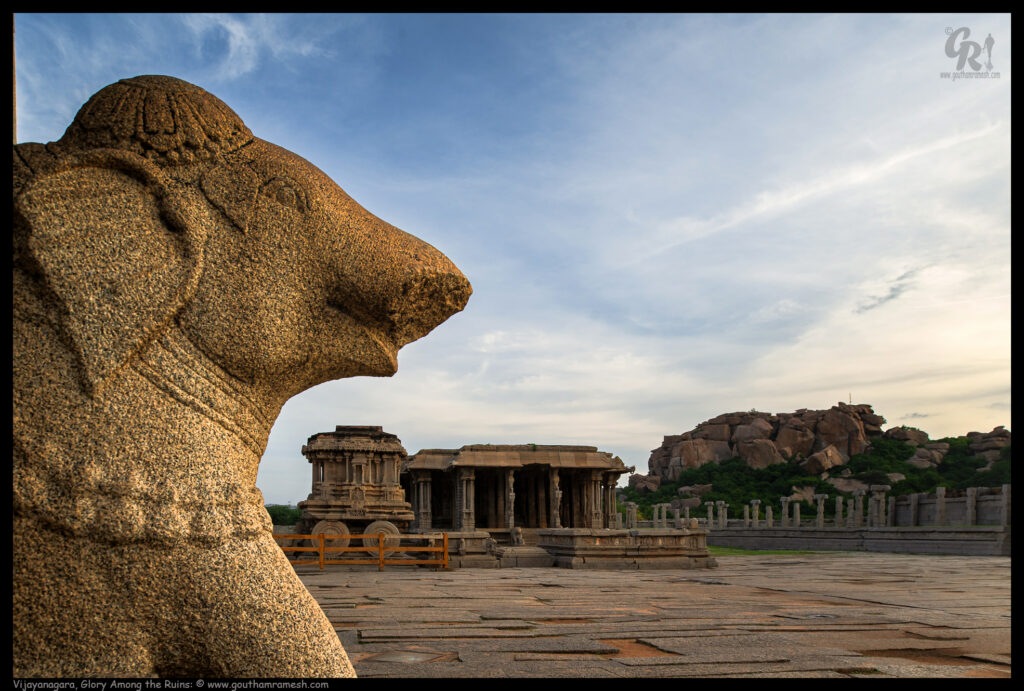
Almost everyone who enters the Vijaya Vittala complex wants to photograph the Stone Chariot, and rightly so.. It is one of Hampi’s great visual icons. But iconic subjects create a photographic problem: how do you make the viewer look again?
My answer here was to avoid making the chariot immediately obvious.
I used the broken elephant sculpture extremely close to the camera as a massive foreground element. Its truncated form occupies almost half the frame, while the Stone Chariot sits deeper within the scene.
The elephant therefore becomes both subject and frame.
There is another reason I enjoy this composition.
- Both objects are incomplete.
- Both have survived.
- Both belong to the same fractured architectural landscape.
The photograph is therefore not simply about the celebrated Stone Chariot. It is about the fragments surrounding it.
Hampi’s beauty does not come from pristine survival.
Its beauty comes from survival despite destruction.
Broken elephants, roofless halls, fractured sculptures and standing pillars all participate in the story.
The ruins themselves are the monument.
Echoes Beneath Vittala
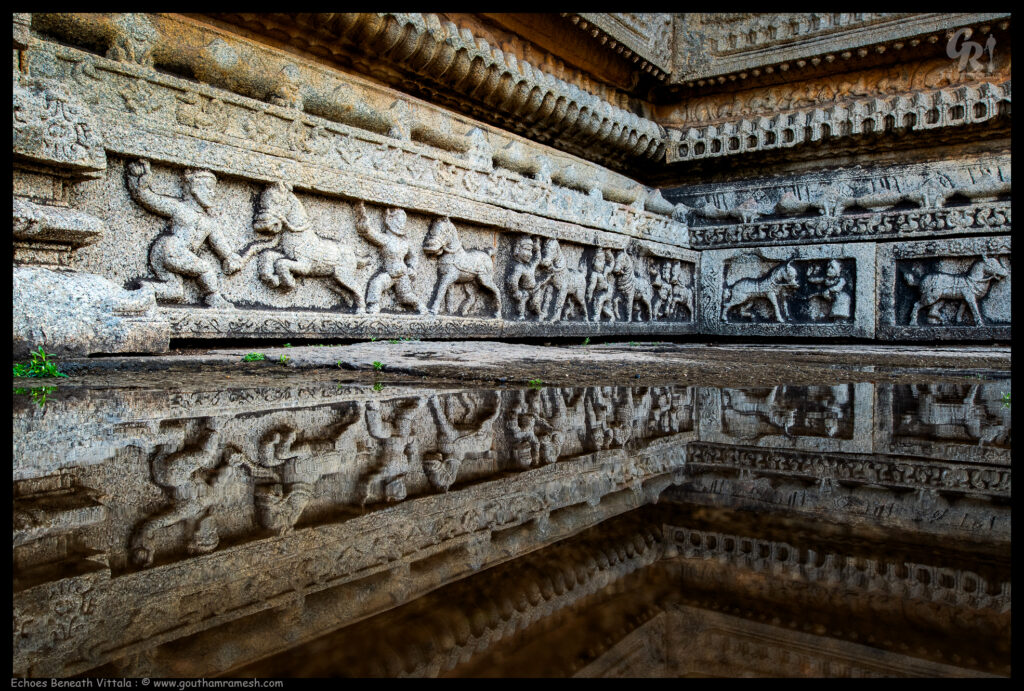
After rain, Hampi occasionally gives photographers an unexpected gift.
- Water.
A small puddle can completely transform a familiar wall.
Here the sculptural friezes at the Vittala complex appear twice: once in stone and again in reflection.
I deliberately placed the camera extremely low so that the puddle occupied almost half of the composition. Had I photographed from normal eye level, the reflection would have become a small decorative feature.
From ground level it becomes the photograph.
The reflected sculptures are imperfect. Small disturbances in the water soften them and the tones change between stone and reflection.
That imperfection is precisely what attracted me.
There is something appropriate about seeing Hampi through reflections.
We never encounter the Vijayanagara Empire directly. We encounter fragments: archaeology, stories, records, sculptures and ruins.
Everything we understand today is, in some sense, a reflection of what once existed. The puddle therefore became more than a compositional device. It became a metaphor.
Crowned by Clouds
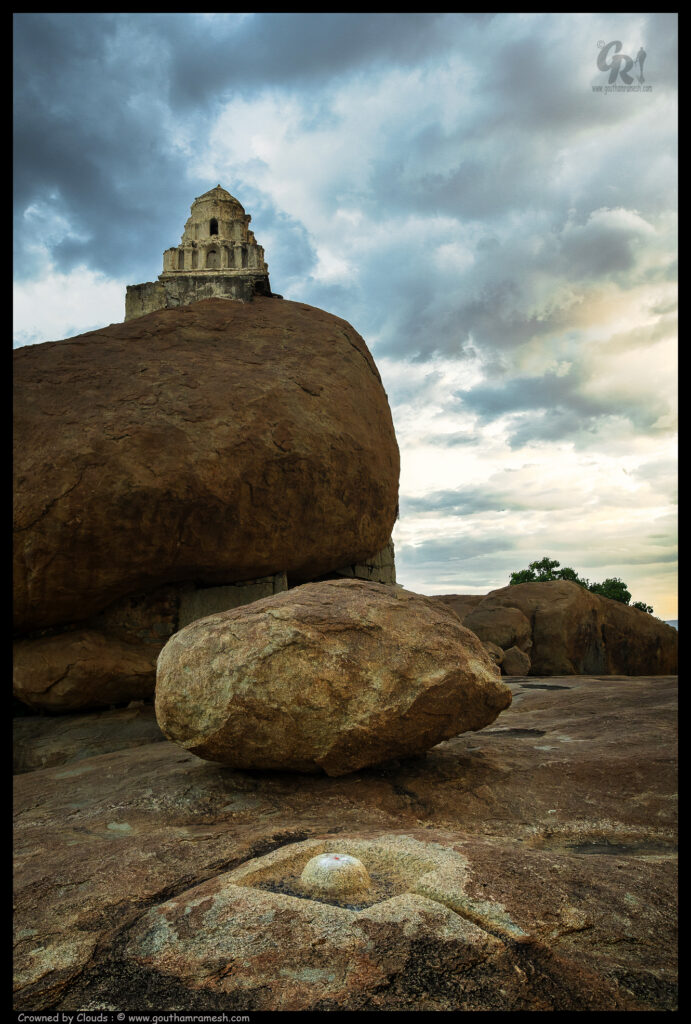
Architecture in Hampi frequently seems to emerge directly from the boulders.
This vertical composition was created to exaggerate precisely that relationship.
Instead of photographing the shrine independently, I placed the large boulder prominently in the centre and allowed the small structure above it to appear almost like a crown.
Another linga occupies the immediate foreground. The eye therefore moves through three distinct layers: foreground carving, massive boulder and architecture above.
But the real scale of the photograph comes from the sky.
The dramatic clouds occupy more than half of the frame, making even the enormous boulder appear comparatively small.
This is one of those situations where changing the orientation changes the story completely. A horizontal frame would naturally emphasise the landscape, while the vertical frame draws attention to height, ascent and hierarchy. The eye moves upward in stages: from stone to boulder, from boulder to architecture, and finally from architecture to sky.
Sometimes perspective is simply about discovering the direction in which the photograph wants to breathe.
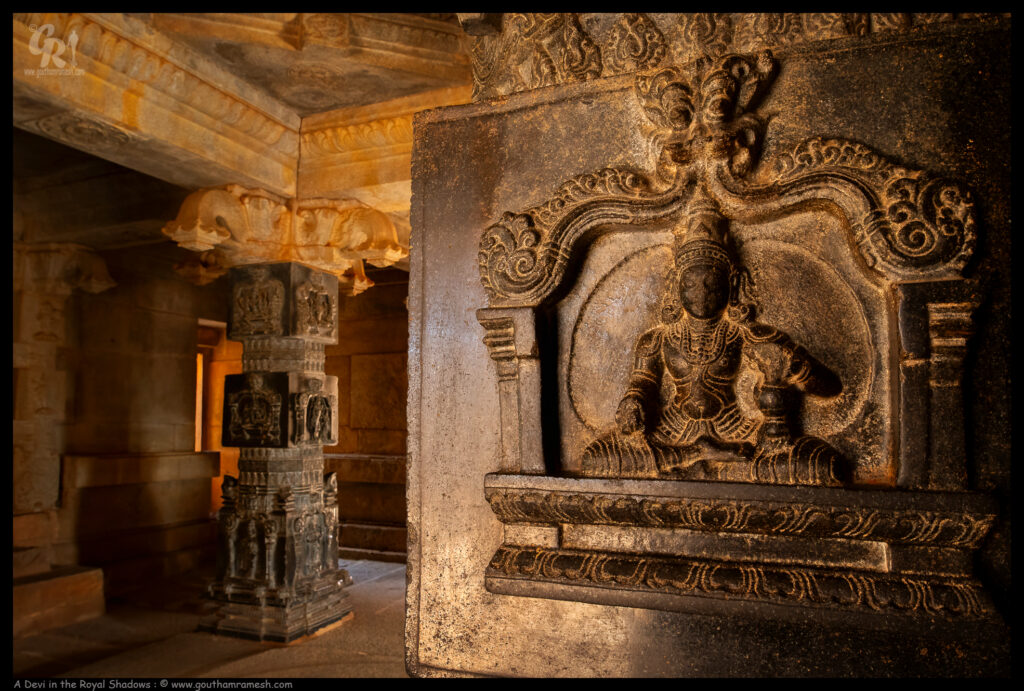
A Devi in the Royal Shadows
Some photographs require distance.
Others demand intimacy.
Inside the Hazara Rama Temple, the quality of light changes completely. The bright exterior gives way to soft illumination, reflected light and deep shadow.
I wanted to use that darkness rather than fight it.
The Devi sculpture occupies the foreground, illuminated just enough for the jewellery, posture and carved details to emerge. Behind her, the darker interior recedes through layers of pillars.
The perspective places the viewer almost beside the sculpture rather than observing it from across the hall.
You move through them.
- One pillar hides another.
- Sculptures appear and disappear with changing light.
- Doorways reveal fragments of another space.
The frame therefore attempts to reproduce that experience.
The photograph is not only about the Devi.
It is about discovering the Devi in the shadows.
Sometimes the architecture itself tells you where to stand simply by allowing light to fall on one small part of it.
Sentinel of the Royal Enclosure
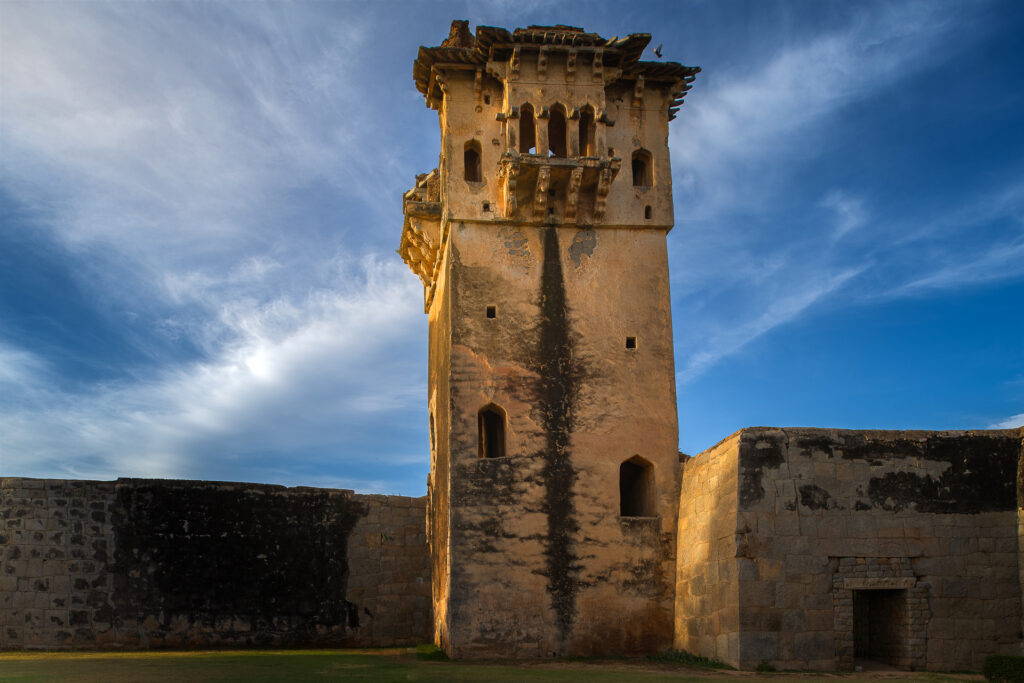
Some structures in Hampi command attention not through ornamentation, but through sheer presence.
This solitary tower in the royal precinct near the Lotus Mahal immediately drew my eye because it rises so decisively above the surrounding walls. Unlike the elaborately carved temples elsewhere in Hampi, its architectural vocabulary is restrained. Large surfaces, narrow openings, projecting balconies and a commanding vertical form give it an entirely different character.
For this photograph I deliberately kept the viewpoint straightforward.
There was no need for an exaggerated foreground or an unusual angle. The tower itself had enough personality. I allowed it to rise almost centrally into the sky, while the much lower walls on either side reinforce its height. The warm light striking portions of the structure reveals its texture, weathering and scars, while the blue sky provides a clean separation behind it.
Standing there, I could not help thinking of it as a silent sentinel.
Empires disappear. Courts fall silent. Walls collapse. Yet some structures remain standing, watching over a landscape whose meaning has completely changed.
That is the perspective I wanted here, not merely an architectural record of a tower, but the feeling of something that has stood witness to the passing of Vijayanagara itself.
Elephant Stables, Beyond the Obvious View
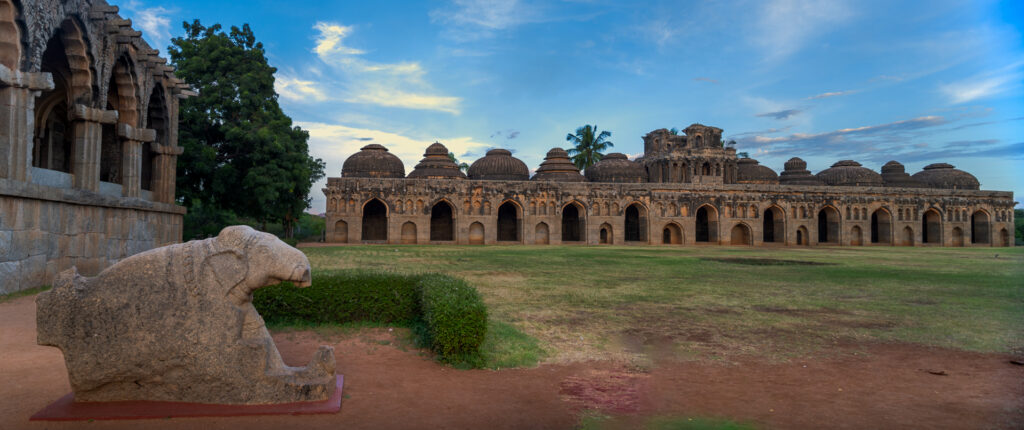
The Elephant Stables present a completely different challenge.
The structure is enormous and extraordinarily horizontal.
When I first stood before it, I wanted to communicate that length, but I also wanted something in the foreground to anchor the photograph.
Then I noticed the broken elephant sculpture.
That became the key.
The elephant fragment occupies the left foreground and immediately establishes a relationship with the building behind it. Instead of photographing the stables as a straightforward architectural elevation, the sculpture gives the image context, depth and a little visual irony: a stone elephant standing before the architecture associated with royal elephants.
But there was a technical problem.
My 24mm lens could not comfortably include everything I wanted: the foreground sculpture, the structure to the left and the entire sweep of the Elephant Stables.
This is where the Nikon PC-E 24mm became invaluable.
I rotated the PC-E 24mm and shifted the lens progressively across the scene, making six overlapping exposures with roughly 50–60% overlap before merging them into a panorama.
Unlike simply swinging the camera for a conventional panorama, shifting the lens allowed me to maintain a more controlled architectural perspective.
And this photograph represents something fundamental about the entire series.
- Sometimes perspective is artistic.
- Sometimes it is physical.
- Sometimes it is technical.
And occasionally all three must work together to create the photograph you imagined when you first stood before the scene.
Perspective Is the Photograph
When I look back at these images, I realise that very few of them are really about the monument alone.
One photograph is about a flower, another begins with a puddle, and another uses a broken elephant to lead the eye into the ruins. A solitary figure becomes a measure of scale against an immense landscape. In one frame, the sun slips through vegetation; in another, carved horsemen become visually larger than the architecture behind them. Sometimes the camera is almost touching the ground, while at other times the sky is allowed to dominate the composition.
Yet all of them are photographs of Hampi.
That, perhaps, is the lesson this extraordinary place continues to teach me: the subject may remain the same, but the photograph changes completely with the way we choose to see it..
A monument does not have one photograph. It has thousands.
The photographer’s responsibility is not merely to stand before something beautiful and record it. It is to move around it, question the obvious viewpoint, look behind it, crouch beneath it, find reflections, watch the changing light and sometimes turn away from the monument completely.
Because photography ultimately begins not with the camera.
It begins with where we choose to stand.
Hampi has been photographed for generations and will undoubtedly be photographed for generations more. The monuments may remain the same, but every photographer arrives with a different eye, a different moment of light and a different way of seeing.
And perhaps that is why I continue returning.
Not to photograph Hampi again.
But to discover another Hampi hidden inside the one I already know.
If this way of seeing Hampi resonates with you, I would love to hear your thoughts. You can leave a comment on Contact page.

Cheers ,
Goutham Ramesh